Lectionary readings: Acts 1:15-17, 21-26 Psalm 1 1 John 5:9-13 John 17:6-19
What an amazing world technology has given to us. Those with family and friends in other parts of the UK, or across the pond, or half way round the world, can now converse face to face via the computer screen; enabling the whole family to ‘get together’ for conversations.
A huge improvement on the days of my parents when family had a weekly phone call, and then often via the phone box at the corner of the street! Family now can be present with us, even though separated by many miles.
The Church has just celebrated Ascension, and Isaac S. Villegas has this to say about what that festival means:
When Jesus withdraws from his followers and ascends into heaven, he becomes present in another sense—present on earth through our lives, present through and in us. Christ gives his body through the church. “God has made Jesus the head over all things for the church, which is his body, the fullness of him who fills all in all,” says Ephesians. After the ascension, we are the body of Jesus. (Ephesians 1:23)
Isaac S. Villegas, https://mailchi.mp/christiancentury.org/faith-after-ascension-348287?e=815ac9f11a
Yet sometimes, to be the body of Christ is really difficult in a fast-changing world. The same technology that allows conversation with loved ones, also brings unspeakable horrors into our living rooms. We see the images of unimaginable loss of life as Covid-19 rages in India.
It reveals that human beings are capable of perpetrating the most awful acts against each other and the planet, as once more we witness escalating tensions unfolding in the Middle East. And sometimes, it feels as though it would be great to escape it all, at least for a while, to regain some sanity.
The prayer in John’s Gospel (often described as the High Priestly Prayer of Jesus) was written with exactly this need in mind; but instead of encouraging retreating from the world, Jesus calls us into full participation with the world. And instead of feeling buffeted and beset, Jesus prays for our protection:
I am not asking you to take them out of the world,
but I ask you to protect them from the evil one.
They do not belong to the world,
just as I do not belong to the world.
John 17:15-16
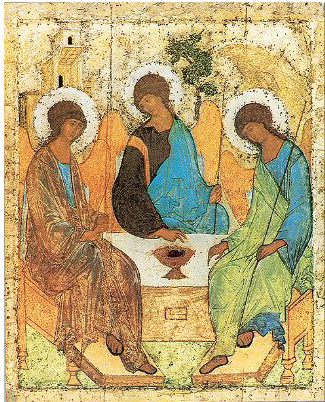
One of the most comforting images that help to contemplate the truth of this is Rublev’s Icon of the Trinity. This remarkable icon shows the relationship of God as a community of being. The divine community is not only the pattern for all Christian communities, but it is the empowering for all human life to reflect the love of God. And we are called into this community; for as we learned last week in John 15, the defining mark of a Christian should be the love we show to others.
The prayer John 17 witnesses to Jesus’ divine authority, and affirms that the revelation Jesus gives to us from God through his words and actions can be trusted. This is God’s beloved Son, who has suffered desertion, torture and death, but raised to new life, now offers life to us all. But Jesus takes the disciples then and now, beyond the resurrection, into abundant life. (John 10:10) I like the phrase abundant life, because there are all kinds of confusion about eternal life, being ‘pie in the sky when you die’. Unless of course, you know John’s Gospel:
And this is eternal life,
that they may know you,
the only true God,
and Jesus Christ whom you have sent.
John 17:3
So at the time when Jesus prepared to depart from the world he prayed that God would protect the disciples (v 11). This is not some ‘superpower’ as beloved by comic book story tellers, but more of the kind of care and attention that all good parents would wish to show to their children. You cannot prevent harm coming to them, nor can you always stop them ‘going off the rails’, but at least you can prepare them for life and give them the kind of emotional, ethical and spiritual resilience that will allow them to make good choices.
Amongst the community of believers, this protection allows the community to love one another – which is often harder than it sounds! Earlier in John’s gospel, we read that God loved the world so much that Jesus was gifted to us. And now, just as Jesus was sent, so too are his followers to fulfil the mission of love to the world. But to just sent, but given the means by which to do this.
Near the end of the prayer Jesus explained it like this: Sanctify them in the truth; your word is truth. (17:16) ‘Sanctify’ is not a word used often in every day speech, but a quick look in a dictionary tells us it is about being made holy, or approved by God. Much more frequently in English, the related word ‘sanctimonious’ crops up!
I guess you probably have your own favourite hypocrite in literature: someone like Mr. Brocklehurst (Charlotte Bronte’s Jane Eyre). We learn how Jane and the other unlucky girls at the Lowood ‘school’ are denied adequate food, heat, clothing and compassion while the sanctimonious Mr. Brocklehurst and his family live a life of luxury whilst he argues that miserable austerity is good for the poor.
Instead, we are called to a life of holiness, which I think really means that through our baptism we are called to discover what it means to truly live and to live fully; by meeting the needs of others, by enabling forgiveness and reconciliation, by radiating the love of God, and praying for the world in which we live.
If you prefer, it is a radical breaking in of the kingdom of God into the everyday lives of God’s people. So perhaps, as we read this prayer can we hear Jesus speaking words to us that will help us as we work in our local communities. And whilst we cannot physically go to India or to Jerusalem, we can pray for healing, for wisdom and for peace.
 Worship at home