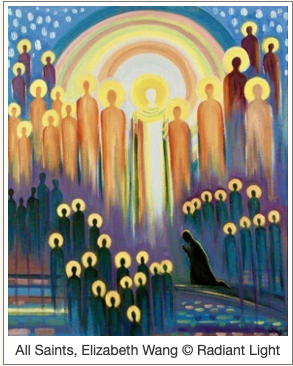
For All Saints, I used the following pieces of music in church:
- For all the saints who from their labour rest
- Soon and very soon we are going to see the King (Andrae Crouch)
- Worthy is the Lamb & Amen from Handel’s Messiah
And the reading was Revelation 7:9-17
There is a thin line between life and death, which most of us prefer not to be reminded about. Until of course, there is that death of a loved one, or the horror of a tragic accident, or the challenge of violence, brutality and war on our TV screens. Yet in reality, we live with the tribulation that cancer, Alzheimer’s, domestic violence, hunger and homelessness and the insanity of war, brings into all our lives. By contrast, heaven is the place of freedom from hunger and thirst, and from any kind of pain or injustice.
At this time of the year we commemorate a triplet of days –Halloween, All Saints, and All Souls (from October 31-November 2) – which marks a sacred space in the turning of the year.
Among the gifts to the church still to be found amongst both Catholics and Orthodox Christians is the link with the departed saints of God. Good rational Protestants on the other hand, try hard to escape the commercialised festival of Halloween with its sugar-rich, ghoulish celebration. (Even the media recognises that Halloween is the next most profitable season after Christmas for shop keepers.)
We may give a brief passing nod to All Saints – but probably only if you were brought up Anglican – and as for all souls, well we can only wonder at such a strange custom. But in ‘throwing out the proverbial baby with the bath water’, we are in danger of missing this vital reminder that the church of Christ is both militant AND triumphant.
So let’s just pause, and reflect on that thin line between life and death; that sacred space which is sometimes referred to in Celtic tradition as a thin place, where past, present, and future intertwine, and the veil between worlds becomes permeable.
Peering through the veil
So what might we see, if we were to peer through the veil between heaven and earth to look upon the church triumphant? In St John’s stunning apocalyptic vision, the lines are blurred between those things which afflict us now, and the promised world free from pain, suffering and fear. He enables the veil to become thin, so we can peer through. He draws the future of God into the present of our lives. St John reveals, or unveils heaven, bringing it down to earth to show us how things really are in God’s world, not the way we have come to think they are.
The vision seen by John has one straightforward message: God wins through the power of love and evil will be defeated. God is making all things new: there will be no need of sun or moon, because God and the lamb will be all the light that everyone needs. Crying and pain and sorrow will be gone, and the world will attain its God-given potential as a place of order, structure and design; a place ruled by love.
Worship – the church militant and triumphant.
However odd the book of Revelation sounds, at chapter seven, readers are drawn into the throne room of God to participate in a glorious act of worship. In this space singing is not only permitted, but expected, because this is one of the ways in which God’s people give honour and power and might to God. So however weird our worship may be at present, as part of the church on earth and the church in heaven, we are surrounded by the heavenly choir in full voice. Marvin Ellison puts it like this:
Even in the midst of evil, war, social upheaval famine, luxury and greed, saints cannot keep from singing! Though sickness unto death, persecution, hurricane, tornado, earthquake, tsunami, and state-sanctioned injustice may confront them, saints cannot keep from listening!
Marvin Ellison, Feasting on the Word: Preaching the Revised Common Lectionary. (Year A, Volume 4: Season After Pentecost 2). (Louisville: Westminster John Knox ,220)
Tears in heaven?
But it is the unexpected that caught my attention in this text:
and God will wipe away every tear from their eyes.
In that world beyond the veil, we have come to expect that the imperfections of this world have all been removed. Yet the tears seem to still be there, waiting for God’s attention.
I suspect it was a word of comfort to early Christians undergoing great trials and tribulations under the Roman Empire. But perhaps it should offer words of hope and encouragement to those still on the Christian pathway:
Before the throne of God there is a radical inclusivity that does not prioritise white over black, men over women, those who possess seemingly perfect bodies over those whose bodies don’t always function as they would like. Strikingly, when the Risen Jesus appears to the disciples, he bears the marks of crucifixion; or as Charles Wesley phrases it:
Those dear tokens of his passion, still his dazzling body bears.
I’m still thinking this one through, but I suspect that redemption is so much more than we might expect, and every tear that has ever been shed, and every act of kindness done stands witness in heaven to the less than perfect nature of the world we see around. And we will all be brought before God. But since we still have a journey to complete, our task is to continue to bring heaven down to earth.
!912, Royal Albert Hall, William Booth (founder of the Salvation Army) gave his final address which included these words:
While women weep, as they do now, I’ll fight; while children go hungry, as they do now I’ll fight; while men go to prison, in and out, in and out, as they do now, I’ll fight; while there is a poor lost girl upon the streets, while there remains one dark soul without the light of God, I’ll fight, I’ll fight to the very end!
William Booth
These words hit hard in the midst of a pandemic, which has raised issues around child poverty and free-school meals, and the dangers of domestic abuse during lock-downs.
I want to suggest that when we sing (when permitted!) for all the saints who from their labours rest, it is both a prayer of thanksgiving, and also a call to all who still strive to bring in the yet more glorious day of God;’ kingdom of grace and justice.
A Prayer
We pray for the coming of God’s kingdom.
You sent your Son to bring good news to the poor,
sight to the blind,
freedom to captives and salvation to your people:
anoint us with your Spirit;
rouse us to work in his name.
Father, by your Spirit
bring in your kingdom.

Send us to bring help to the poor
and freedom to the oppressed.
Father, by your Spirit
bring in your kingdom.

Send us to tell the world
the good news of your healing love.
Father, by your Spirit
bring in your kingdom.

Send us to those who mourn,
to bring joy and gladness instead of grief.
Father, by your Spirit
bring in your kingdom.

Send us to proclaim that the time is here
for you to save your people.
Father, by your Spirit
bring in your kingdom.

Lord of the Church,
hear our prayer,
and make us one in mind and heart
to serve you in Christ our Lord. Amen.

(I regret, with apologies, that I cannot find the source of this prayer)
 Worship at home