Exodus 12:1-14 Psalm 149 Romans 13:8-14 Matthew 18:15-20
Introduction:
Just this week, someone said, ‘Autumn has arrived two weeks early this year!’ Whilst, we all know what that phrase means, I am firmly amongst those who believe that mother nature does not have access to a Gregorian calendar, and therefore the seasons must surely come at precisely the right moment!
Time is a peculiar concept, but I am always grateful to the person who gave me a copy of M. Quoist beautiful prayers. Written in the 1950’s, by a French catholic priest this collection of prayers about everyday life, still resonate today. (Still in print if you wish to read these prayers).
Freedom-time
Michel Quoist challenges us to think about time. Human beings have become increasingly obsessed by time; I guess most people today own at least one watch, and can access a very accurate account of time through mobile phones or other devices carries around in bags. Gone are the days when our lives were determined by the length of daylight and the seasons of the year. Even in church, a clock adorns the wall for fear the preacher may go on too long. Yet none of these tells us about the really important things we need to know about time, so eloquently stated by Quoist:
Lord, I have time,
I have plenty of time,
all the time that you give me,
the years of my life,
the days of my years,
the hours of my days,
they are all mine.
mine to fill quietly, calmly,
but to fill completely, up to the brim.
to offer them to you , that of their insipid waters
You may make a rich wine such as you made once in Cana of Galilee…
Michel Quoist, Prayers of Life (Dublin: Gill & Macmillan, 1963), 76
Here is a reminder of both whose time is it and what it is for.
The reading from the book of Exodus begins with two references to time. The first tells of the point in the calendar -‘The first month of the year’: highly appropriate for Methodists as we begin a new Connexional year. It is a reading which still holds useful lessons for today.
At first glance, the passage seems to be about the time when the children of God were making their preparations to leave Egypt and to set out on a journey to the Promised Land. Yet there is a deeper significance which discloses how the children of Israel enter into God’s time. For the Israelites in Egypt, it was done through a ritual meal and the proclamation or passing on of the important stories and traditions that came to define the people of God.
And it is a powerful story which is still commemorated today in Jewish homes around the world, and just as commanded, the meal is accompanied by a story. As a group of people, they were instructed to tell this story to each new generation of children (Exodus 12:26) and to the alien or stranger in their midst (Exodus 12:48). Powerful stories need telling to each new generation; so here is our first challenge – how are we telling the story today?
Let my people go
According to the book of Exodus, life in Egypt had become a story of harsh, grinding slavery. Now God was about to do something to help the people; and it becomes the tale of freedom, from slavery to the powerful Egyptian empire. And it is a powerful story (an enduring paradigm), because it is one in which we find parallels and new meaning in every generation. It is no accident, that the account of the ancient Hebrews was one treasured by the slave people of the United States. And with the resonant voice of Paul Robeson, many of us have become aware of that plaintiff cry: let my people go. In the middle of the 19th century, the American Civil War waged over the issue of freedom for all, yet we still hear the cry in the voices of all those who protest for racial justice today. The account in Exodus is indeed a powerful story, which should challenge the church
Another great old theme in the hymnody was best summed in Samuel Stennett’s hymn ‘On Jordan’s stormy banks I stand, with its refrain: ‘I am bound for the promised land ….’
If we are people bound for the promised land, then we are people on the move, pulling up tent-pegs; part of moving into a new future, involves a letting go of the past. Not forgetting it, the past experiences are those which have shaped us as the people of God. This is particularly important as we contemplate what church should be, as we live with Covid-19.
Transition-time
Time for God’s people is for evermore freedom-time, but it is also transitional.
The second marker of time is twilight, a transition time; between day and night– it is reminder that traditionally Jewish people count days from sunset to sunset. The doorposts marked, it would have reminded people that they were about to leave those homes for good, with no idea where they might arrive. As for the people, they were to eat dressed for travel – sandals on feet, staff in hand, and in haste (12:11).
I wonder what it feels like to leave behind the known, to travel on flimsy craft across seas and oceans? I wonder what desperation pushes modern exoduses of people from their homes?
Do we ever have a sense of that powerful urgency to move on in our faith-life, our spiritual journey? Or are we so complacent and comfortable where we are? The last few months has shaken everyone out of the sense of ‘business as usual’, but where are we headed?
Unity-time
‘Time for God’s people is forevermore freedom, it is transitional, but it is also time to come together. Online platforms for worship have value, particularly for the housebound, but I was profoundly moved at my first live service in a church building as I heard voices quickly praying together the words of the Lord’s prayer. It is deeply significant that it begins, ‘Our Father…’
We belong together and we work together to support one another, otherwise the moving on can be very difficult indeed. Look how the Israelites were asked to share a meal if their own family was too small. Why is there such an emphasis on looking out for one another in the good news of the kingdom of God?
Simply because the book of Exodus proclaims that God is ultimately and primarily gracious and merciful and forgiving (Exodus 34:6-7). This is important, because some preachers focus on the wrath of God – which should never be overlooked. However, when I reflect on the overall theme of scripture, it is the grace and mercy that sets the defining pattern. How then, you might ask, do I understand those other parts of scripture?
I always hoped I was a loving parent when bringing up children, but just occasionally I sometimes had to issue warnings to my girls – don’t play with matches, they can be dangerous; don’t touch the iron it is hot. Because as parents we know that certain things can be harmful, and we know that for every action there will be a consequence. And as it turned out, children sometimes must learn the hard way! There are consequences to sustained rebellion and disobedience against God and God’s purposes for the world, consequences that inevitably spill over to future generations.
Never is this more true than for those who suffered abuse as children, where the consequences of bad parenting reaching down through more than one generation, to their children’s children. It was to be Egypt’s centuries-long oppression of Israelite slaves (Genesis 15:13; Exodus 12:40) and Pharaoh’s stubborn refusal to heed God’s repeated warnings through the many plagues and ecological disasters that Egypt endured, that ultimately brought disaster upon the nation. They did not heed the warnings and ended up with severe consequences.
Time and time again, we have seen through the pages of history, the disasters caused by those whose rule is despotic. But this story doesn’t just speak to world leaders who act as pharaoh, it speaks to the church and all who are appointed as leaders. Deeds which do not seek to build the kingdom of God, cause ripples of harm, as the churches have discovered when looking at those past cases of abuse.
Catholic Spirit
But to get back to thinking about unity, John Wesley famously preached on the ‘catholic spirit’ (Sermon 39) based around this quote from 2 Kings 10:15 (NKJV):
Is your heart right, as my heart is toward your heart? … If it is, give me your hand.
Wesley’s sermon unfolds to remind the hearer of those two great commands about loving God and loving one’s neighbour. And about sharing this commitment with all who love the Lord Jesus Christ. It is the kind of relationship that goes beyond small disagreements in theology, doctrine and worship-styles, but focusses on the things that are central to our faith.
We have time, all the time that God gives to us, to live in freedom, to live in unity and to work out how to move ahead. Because God will be there with us.
A hymn and a prayer:
Christ, from whom all blessings flow, perfecting the saints below,
hear us, who Thy nature share, who thy mystic body are.

Join us, in one spirit join, let us still receive of thine;
still for more on Thee we call, thou who fillest all in all.

Closer knit to thee, our Head, nourished, Lord, by thee, and fed,
let us daily growth receive, more in Jesus Christ believe.

Never from thy service move,  needful to each other prove;
use the grace on each bestowed,  tempered by the art of God.

Love, like death, hath all destroyed, rendered all distinctions void;
names, and sects, and parties fall: thou, O Christ, art all in all.
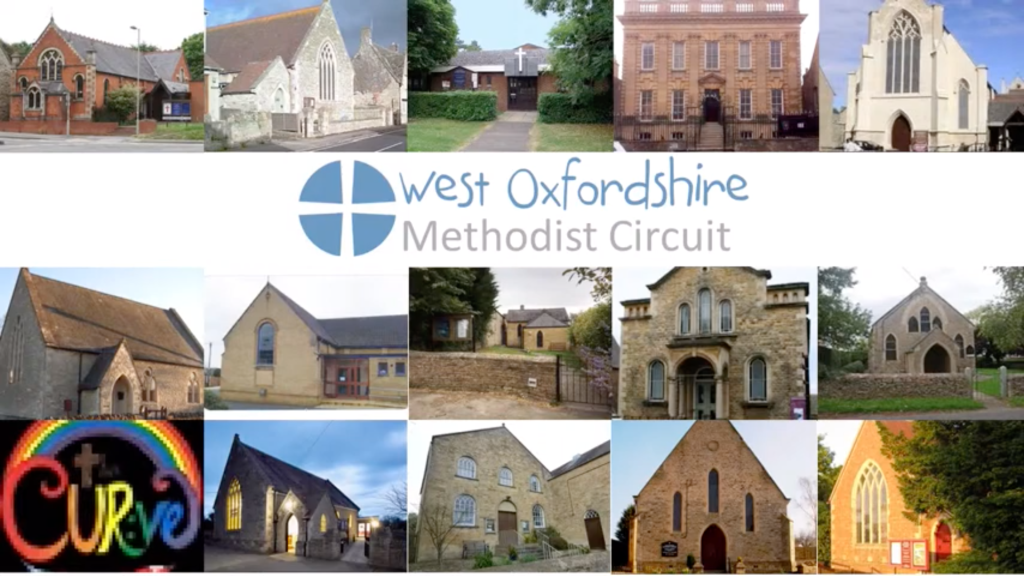
An apology and an unashamed advert: ironically, I ran out of time this week, so this post is late. The excuse is that we were preparing to have a special service to mark the beginning of a change of Circuit name, welcoming new churches and a new colleague. So here is a link to our YouTube service – https://youtu.be/qinxeBwoxRQ (which includes prayers and hymns!)
 Worship at home