Genesis 18:1-15 Psalm 116:1-2, 12-19 Romans 5:1-8 Matthew 9:35—10:23
Call to worship
1I love the LORD, because he has heard
my voice and my supplications.
2Because he inclined his ear to me,
therefore. I will call on him as long as I live.
3The snares of death encompassed me;
the pangs of Sheol laid hold on me;
I suffered distress and anguish.
4Then I called on the name of the LORD:
‘O LORD, I pray, save my life!’
5Gracious is the LORD, and righteous;
our God is merciful.
12What shall I return to the LORD
for all his bounty to me?
13I will lift up the cup of salvation
and call on the name of the LORD,
14I will pay my vows to the LORD
in the presence of all his people.  Psalm 116
I'll praise my Maker
while I've breath;
and when my voice
is lost in death,
praise shall employ
my nobler powers;
my days of praise
shall ne'er be past,
while life and thought
and being last,
or immortality endures.
Happy are they
whose hopes rely
on Israel's God!
He made the sky,
and earth and sea,
with all their train:
his truth for ever
stands secure;
he saves the oppressed,
he feeds the poor,
and none shall find
his promise vain.
The Lord pours eyesight
on the blind;
the Lord supports
the fainting mind;
he sends the labouring
conscience peace;
he helps the stranger
in distress,
the widow and the fatherless,
and grants the prisoner
sweet release.
I'll praise him while
he lends me breath;
and when my voice
is lost in death,
praise shall employ
my nobler powers:
my days of praise
shall ne'er be past,
while life and thought
and being last,
or immortality endures.
Isaac Watts (1674–1748)
Prayer
Lord God, we come as ones blessed
by the abundance of your grace poured out on us.
As we call on your name,
we take these moments of restfulness
to lift our hearts, our worship to you.
Still our restless minds as we come into your presence.
Lord God, you seem as pleased
with our clumsy attempts at praise and worship,
as a parent who looks at their child’s artwork,
wondering what it is supposed to be.
But we sincerely want to offer you of our very best efforts
as we contemplate the depth of your love
and the breadth of your grace to us.
In the mess that is our response to your grace,
you did not abandon us:
In our lack of care and justice
for the ethnically diverse people you have made,
forgive us and inspire us to new ways of relating.

In our lack of care for this beautiful world,
which is your gift to us,
forgive us and inspire us to ways of life
that place fewer demands on the resources of our planet.
God’s word declares that
those who genuinely acknowledge their wrong doing
receive forgiveness;
therefore, hear the word of grace:
your sins are forgiven.  Amen

The Hospitality of Abraham and Sarah
Abraham and Sarah were nomadic people who – in Genesis 18 – had pitched their tent at Mamre, no doubt a place offering good pasturage for their flocks. It is a life-style that few in the UK see in towns and countryside now. And when people do arrive in temporary, mobile accommodation, they are not always greeted with kindness. But in true Middle-Eastern tradition, when Abram saw the strangers approaching, he rushed out to greet them in the time-honoured way. The visitors were seated under the shade of a tree offered rest and shelter from the blazing heat of the day and Abram offered water to wash and food for refreshment.
One of the most interesting features of lock-down has been a return to a more ‘human’ speed of life. One of the shocks we had on leaving Cornwall, was the frenetic pace of life in the SE of England; and observation reveals that frenetic pace of life, does not always lead to greater achievement! The pace of life in Cornwall always felt much slower, to the point where our local village hostelry carried a notice over the bar where food was ordered, ‘we do not do fast food’. Underneath was a description of the freshness and preparation of their dishes. No doubt visitors, perhaps far more used to a faster pace of life, grew impatient waiting for freshly prepared menus; if they felt that Cornish pubs offered slow-food, what might they think about the ultra-slowness of life in ancient times? The first joy of this story then, is the reminder of the leisurely nature of ancient hospitality: the bread had to be made, not pulled from its wrapper and sliced, and the calf slaughtered and butchered. There was also a huge financial cost involved, particularly bearing in mind that this meal was not prepared for family members or friends, but for total strangers.
They show hospitality to strangers only to discover that they have entertained angels. (Hebrews 13:2) Other than the introduction – where these visitors are described as divine beings for the benefit of the audience – Sarah and Abraham have no idea who their guests might be until they enquire after Sarah by name. (Culturally, it would have been quite immodest for Sarah to be in the presence of strange men, so she was listening behind the flap of the tent!)
As we discover from the narrative, the couple are well beyond child-producing years, and unsurprisingly Sarah laughed at the news – it was honest laughter, full of surprise and delight, of shock and disbelief! But it raised an important question: is anything too wonderful for the Lord?
God understood her disbelief and dealt gently, even humorously with it, for the child is to be named ‘Isaac’ or laughter. At his birth, many come to join in the laughter over the gift that God has given to the old couple in fulfilment of the covenant.
Yet this story also deals with the all too human fear and worry that human beings carry. Sarah and Abraham, did not find waiting for God’s time does not come easily; the story in Genesis reveals how they have already tried to force God’s hand with the slave-girl Hagar and the birth of Ishmael. As the old saying goes: more haste, less speed!
Active waiting on God
Yet active waiting should never be fearful or fruitless. Both the letter to the church at Rome and the Gospel of St Matthew were probably first read by people who were beginning to suffer for their faith. Living through tough times, really seems to slow things down. Carefully laid plans – both personal and in church life – do not seem to be able to go ahead, and if they do, it is not quite how we imagined it to be. However, according to St Paul, the kind of active waiting brought about by suffering, whether it was persecution, or waiting for the child of promise for Abraham and Sarah, is character forming:
3And not only that, but we also boast in our sufferings, knowing that suffering produces endurance, 4and endurance produces character, and character produces hope, 5and hope does not disappoint us, because God’s love has been poured into our hearts through the Holy Spirit that has been given to us.
It is precisely here that all covid-19, lock down fidgets need to become disciples in the divine school; learning to rest secure in the knowledge of God’s love for us (and there is no easy way to learn this lesson). I have no doubt that the church of God will survive, but probably not as we know it!
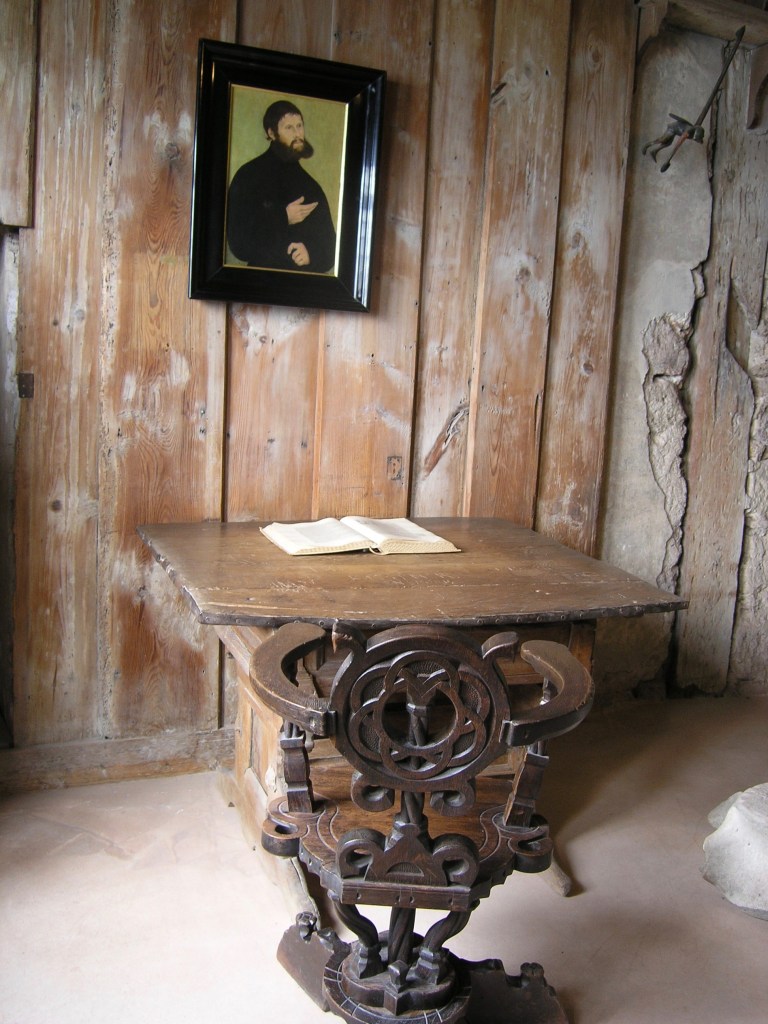
Luther’s Lock down
Five hundred years ago, Luther found himself excommunicated, and locked down in hiding in the Wartburg, he spent his time praying and translating the New Testament in to the German language. However, it was not an easy time for Luther, plagued by theological attacks from his opponents, and his own self-doubts. There is even a mark on the wall where he is reputed to have flung the inkpot at the devil! Waiting on God formed part of St Paul’s journey of faith, it enabled Luther to come through a difficult period in his life, and it should still from part of the spiritual discipline of those who follow Christ today.
It was of course, Luther’s preface to the Epistle to the Romans which contributed to John Wesley’s assurance of faith in 1738. And it is the emphasis on salvation as a divine work of grace, that still underpins the faith of those who follow in the Wesleys’ footsteps:
Amazing love! How can it be that thou, my God shouldst die for me? Charles Wesley, 1738
Living in tough times
Finally, our Gospel reading reminds us of a sense of calling (chapter nine – see verses 35-38), the commissioning of the disciples (10 verses 1-15) and then the last part (16-23) which is devoted to living in tough times. For the early disciples, it came as persecution in the synagogues. Lack of understanding of the faith by civic authorities, and the concerns of divided church communities. But here is the great reminder that Jesus is motivated by compassion. The phrase ‘like a sheep without a shepherd’ is telling. Jesus associated with the people but saw that there was no leadership amongst the people. This wasn’t a complaint about lack of stewards to run the local church, but a pointed political comment against those whose duty was to provide national leadership at that time. So, for those who don’t like Bishops to speak in the market place, and challenge political leaders, perhaps a biblical view of religion and politics is far more nuanced than they might suppose!
Many people have made mention that part of the advantage of the lock down has been time for greater devotion to prayer and scripture-reading. And we have much to pray about. But part of our understanding of prayer might be to relearn or develop the art of waiting on God. That deep seated sense of peace in remaining held by the love of God, that underpins not only what we do, but more importantly, who we are.
Praying for others
Lord, just like the disciples of old,
you call us to follow you,
to share the good news of your kingdom,
not just with words but with practical acts as well.
Lord hear us, Lord gracious hear us
We come with thankful hearts,
remembering your goodness to us,
your careful leading and guiding,
and that invitation to wait quietly in your presence.
Lord hear us, Lord gracious hear us
We thank you for the vision you have given to your church:
for those who rejoice as they move out of lock down,
for those who seek to minister in difficult situations,
for those who respond to a new calling.
Lord hear us, Lord gracious hear us
We pray for all whose lives are devoted to justice
as they seek to establish your kingdom here on earth:
justice for the environment
justice for all people to expect and receive
fair treatment for who they are
and not on the basis of skin colour, sex or gender, or age.
Lord hear us, Lord gracious hear us
We remember those who still suffer,
those who sit alone for long uninterrupted hours,
and for all who are called to work tirelessly
for the relief of suffering and pain.
Lord hear us, Lord gracious hear us
We remember all who are grieving,
especially where saying goodbye
in the time-honoured way
proved impossible.
The Lord’s Prayer:
Our Father in heaven, hallowed be your Name, your kingdom come, your will be done on earth as in heaven. Give us today our daily bread. Forgive us our sins, as we forgive those who sin against us. Save us from the time of trial and deliver us from evil. For the kingdom, the power and the glory are yours, now and forever. Amen
Blessing
God’s love has been poured into our hearts through the Holy Spirit that has been given to us. So, we go in peace to the work God appoints for us, in the name of the Father, the Son and the Holy Spirit. Amen
 Worship at home